Order the latest issue here
Skip to content Skip to sidebar Skip to footer

News & Views

Turning Petals into Purpose: Tackling India’s Flower Waste with Sustainable Reuse

Every day across India, millions of flowers are offered at temples, weddings, and festivals — only to be discarded hours later. This “sacred waste” often clogs rivers, fills landfills, and releases harmful gases. But a growing movement is transforming what was once pollution into purpose. In Turning Petals into Purpose, writer Jhanvi Kaur explores how…

Read more

When Justice Comes Home: Inter Alia’s Unflinching Gaze at Motherhood and Masculinity

Suzie Miller’s Inter Alia, directed by Justin Martin, is a theatrical gut-punch that refuses to flinch. With Rosamund Pike as Jessica Parks—a Crown Court judge and mother—the play dives headfirst into the murky waters of gender, power, and parental accountability. From the opening rock riff to the haunting shadow play, Inter Alia uses bold staging…

Read more

Stop the Torture of Women with Cancer at HMP Bronzefield

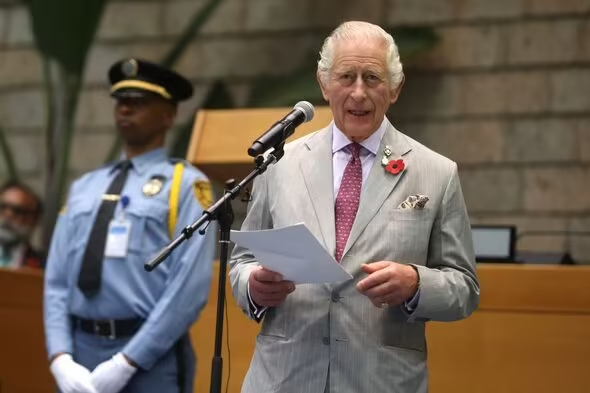
At HMP Bronzefield, women with cancer are chained during treatment, denied hospital care, left to bleed in their cells, and forced to endure filthy, malnourishing conditions. Emergency bells go unanswered, and basic medical rights are ignored. This is not justice—it is systemic cruelty. Meanwhile, King Charles received world-class cancer treatment. Why are women in prison,…

Read more

0

Claudia Sheinbaum, the first female President of Mexico, has been sexually assaulted in the middle of the street, in broad daylight. 

A video circling on social media shows a visibly drunken man coming up behind the President as she is greeting a group of citizens on Tuesday 4th of November. He embraces her from behind, and the President is left with no choice but to extract herself, placatory smile frozen on her face. A political aide then steps in to separate the two. The man has now been arrested, and Sheinbaum has since stated that she will be pressing charges. 

Other than the serious lapse in security evident here, the incident forcibly highlights the indiscriminate nature of the patriarchal structures pervading Mexican society. Many women across Mexico have spoken out about their own experiences of this type of assault, reigniting a global conversation about casual sexism in which this behaviour can be thought acceptable. Indeed the President herself perfectly encapsulated the event: “Si esto le hacen a la presidenta pues ¿qué va a pasar con todas las jóvenes mujeres de este país?” (If they do this to the president, then what is going to happen to all the young women of this country?).

On social media, the search ‘Claudia Sheinbaum’ now brings up alternating videos of either her performance of the ‘El Grito de Independencia’ ceremony or her assault.  In one video, Sheinbaum holds an entire country entranced in the palm of her hand, and in the next, she is stripped back to a sexualised object in the hands of a drunkard. Side by side, these videos represent the glass ceiling that still hangs over all women, including Sheinbaum: that even at her most powerful, a man made her a victim of his desire. Although she is a female president, she is living in a man’s world.

Especially shocking is the fact that this incident occurred just days after Carlos Alberto Manzo Rodríguez, a mayor, was shot and killed at the Day of the Dead celebrations in Uruapan. He was the most recent politician killed in Mexico. In the run up to the election in June 2024, 37 candidates were killed whilst on the campaign trail. 10 municipal presidents have also been killed since the start of Sheinbaum’s government on the 1st of October. Being a politician in Mexico means accepting a certain level of risk, and yet where were Sheinbaum’s security detail when this man approached her?

The risk, which almost every woman has felt and could identify with, was not spotted, or anticipated by her security. And yet, in her speech, Sheinbaum refused to change her behaviour, or that of her security team’s. The act of greeting the people in the streets was a habit set by her predecessor, Andrés Manuel López Obrador, and one she will not give up, refusing to distance herself from the everyday people she works to serve. 

The fact of the matter is that this situation would never happen to a male president. Alongside the threat to life that politicians face in Mexico, Sheinbaum also has to navigate the dangers and barriers that sexism places on her gender. How a woman inhabits power has to take on a different form to that of a man whilst working within the mechanisms of patriarchy – a grey area that Sheinbaum is navigating expertly. 

In her speech, she stated: “mi reflexión es que si no presento yo el delito, además es un delito, pues en qué condición se quedan todas mujeres mexicanas?” (My reflection is that if I don’t report the crime, and this is a crime, then in what condition does that leave all Mexican women?). Here, she subtly acknowledges both the option of not pressing charges – a dilemma that all women face in light of assault – whilst enforcing the man’s behaviour as unacceptable and ultimately criminal. She highlights that this is the everyday plight facing Mexican women in modern day society – one in which she shares. 

Whilst the assault could have been interpreted as undermining her position as president, her body a point of weakness, Sheinbaum has confronted it head on, refusing to let it change her behaviour and using it to instead start a national and global conversation about assault. The pervasive nature of patriarchy persists and impacts women at all levels of society indiscriminately. But it does not define us, just as Sheinbaum is refusing to let it define her presidency.