Order the latest issue here
Skip to content Skip to sidebar Skip to footer
0

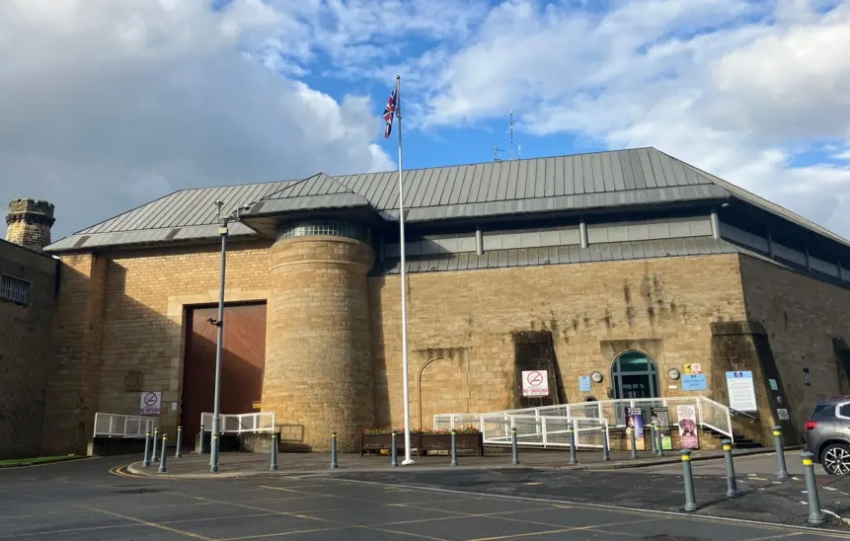
On 10 September 2021, Christopher “Chris” Pearson, aged 42, died in HMP Leeds. His death is now at the centre of a landmark criminal prosecution. Two nurses and a senior prison official have been charged in connection with his death; one of the rare cases in which healthcare staff and prison officers face serious criminal allegations after a prisoner’s death.

What Happened to Christopher Pearson?

Chris Pearson, who had a history of mental ill-health and self-harm, was subject to an ACCT (Assessment, Care in Custody and Teamwork) safety plan in the weeks preceding his death. On 9 September 2021, he damaged his cell, and was moved by prison officers first to another location, and eventually into segregation. During the transfer, he collapsed and had to be carried, according to the Crown Prosecution Service (CPS).

About one and a half hours after arriving in the segregation cell, Pearson was found in cardiac arrest and later pronounced dead. The inquest into his death revealed that he died from cardiac arrest, but critically, this followed a period of restraint by prison officers, and while his condition was being monitored by healthcare staff.

Charges Brought: A Rare Criminal Case

In November 2025, the CPS announced that three individuals at HMP Leeds will be charged in relation to Pearson’s death. The defendants are:

  • Aimee Adams, age 33, a nurse from Worksop – charged with ill-treatment or willful neglect by a care worker (under section 20, Criminal Justice and Courts Act 2015).
  • Merjury Chitadzinga, age 49, a nurse from Mexborough – charged with the same care-worker neglect offence.
  • Leanne Hollis, a prison Custody Manager (PCM) from Barnsley, age 38 – charged with misconduct in public office.

They are scheduled to appear at Westminster Magistrates’ Court on 9 December 2025. 

Why This Case Is Significant

Prosecutions after a death in prison are exceptionally rare. As noted by INQUEST (the charity specialising in state-related deaths), this case marks one of the very few times both healthcare professionals and custodial staff are being held criminally accountable for a prison death. 

INQUEST’s senior caseworker, Jodie Anderson, emphasised that many deaths in prison remain “hidden from public view and scrutiny.” The delay in bringing charges (more than four years since Pearson’s death) has drawn criticism from his family and campaigners, who argue that the slow pace of investigation adds to their suffering.

While there have been isolated prior cases, for example, a former prison officer at HMP Lincoln convicted for falsifying welfare checks, or misconduct convictions following other self-inflicted inmate deaths, the combination in this case of restraint, healthcare neglect, and senior prison misconduct places it among the most serious and precedent-setting.

Who Provides Healthcare in HMP Leeds?

Understanding who was responsible for Pearson’s medical care is central to why this case is under such scrutiny.

Healthcare at HMP Leeds is provided by Practice Plus Group through its “Health in Justice” (HiJ) division. Practice Plus Group is one of the UK’s leading independent providers of prison healthcare, delivering services in dozens of prisons.

Their HiJ team offers a full spectrum of services: from primary care and GP appointments to specialist mental health, substance misuse, dentistry, physiotherapy, optometry, and more. In their governance framework, Practice Plus Group emphasises a holistic “well-being model”, integrating physical health, mental health, substance misuse, relationships, and resettlement, rather than treating each pathway in isolation. 

Specifically for HMP Leeds, psychiatry is subcontracted to the Midlands Partnership NHS Foundation Trust (MPFT). At the time of prior reporting, a locum psychiatrist worked six sessions a week across three days, balancing clinics and multi-disciplinary team meetings. 

Systemic Concerns and What’s at Stake

This case raises fundamental questions about safeguarding vulnerable prisoners, the adequacy of healthcare in custody, and the accountability of prison staff. Key concerns include:

  • Oversight of restraint: Pearson’s collapse happened after being carried by officers during a move, and only later being found in cardiac arrest in a segregation cell.

  • Monitoring during ACCT plans: Given his documented self-harm history, the role of both prison staff and healthcare in the ACCT care reviews comes under scrutiny.

  • Quality of care: The prosecution of both nurses suggests possible failures in healthcare delivery; not just neglect, but a breach of the duty of care owed to Pearson as a patient in a secure environment.

  • Criminal accountability: The charge of misconduct in public office for a custody manager is particularly serious and underscores that senior prison officials may now face criminal risk when systemic failures contribute to a death.

For Pearson’s family, the forthcoming trial represents a long-awaited step toward justice. As Ruth Bundey, solicitor for Pearson’s mother, stated: “the family have had to wait for four years and two months … such a timeframe is unacceptable.”

Why It Matters for Reform

  • Public scrutiny and transparency: This trial may help shine a light on what happens behind closed doors in prisons, particularly in deaths involving both restraint and healthcare.

  • Improving care standards: If convictions arise, it could trigger a broader reckoning in how prison healthcare is delivered, supervised, and audited, especially for those at greatest risk.

  • Policy change: The case could reinforce calls for independent oversight, improved training (e.g., ACCT review training for all staff), and stronger accountability mechanisms when things go wrong.

What to Watch Next

  • The Westminster Magistrates’ Court hearing on 9 December 2025, when the defendants will make their first appearance.

  • How the trial proceeds; whether it leads to a full prosecution or any plea deal.

  • The broader response from prison health bodies, campaigners, and the Ministry of Justice or NHS commissioners, especially given the rarity of such criminal cases.

In Summary

The death of Christopher Pearson at HMP Leeds is more than a tragic loss: it may prove a pivotal moment for accountability in prison healthcare. With two nurses and a senior prison manager facing criminal charges, his case challenges the long-standing reality that few deaths in custody ever lead to prosecution. It raises urgent questions about restraint, mental health monitoring, and safeguards for prisoners who self-harm, and it underscores the role of Practice Plus Group, the healthcare provider in Leeds prison, in a system that is grappling with reform.

Image source: BBC News