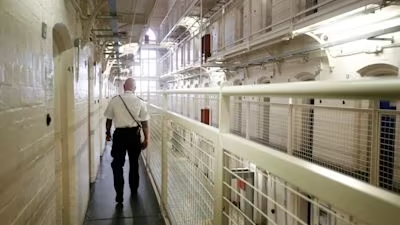
Last year the recruitment figures were billed as a success: more than 700 Nigerians recruited into UK prisons, accounting for nearly one-third of overseas applications into the service and a 12 % share of hires. The headline read well. But the picture today is very different—and hugely worrying.
Because while the service faced deep staffing shortfalls, a policy change now threatens to pull the floor from beneath it.
In July the government raised the salary threshold for Skilled Worker visa renewals to £41,700. That means that overseas-sponsored hires — many of whom earn starting salaries well below that level — will now find themselves unable to renew their visa and therefore will either have to leave; or be sacked when their temporary permit expires. The result? Hundreds of prison officers from overseas likely to exit the system at a time when the service can least afford it.
Look at the workforce numbers. At 30 June 2025 the public-sector prison estate reported 22,702 FTE Band 3-5 prison officers in post. The attrition rate among them: 11.6 % in the past 12 months. Meanwhile, nearly 37.3 % of those officers have less than three years’ experience, and only around a quarter (24.8 %) have 10 or more years’ service. So the service not only has to fill the holes left by those leaving annually—it also has to grapple with an increasingly inexperienced workforce.
True, the national figure for vacancies is murky—MoJ’s own data show only “indicative vacancies” and certain local estimates refer to over 1,000 unfilled posts. But the trend is clear: recruitment and retention difficulties are chronic. Into that context drops a policy that will disqualify a segment of the workforce from staying simply because of a salary threshold.
This is more than a bureaucratic blip. Prison officers are caught in one of the more difficult working environments: antisocial hours, high risk, rising violence and a shortage of hands to keep regimes running safely. The union voice is loud: a recruitment and retention crisis, staff shortages persist, morale weakened—with assaults on staff recorded at 88 a day. The system cannot absorb hundreds of departures without consequence.
Let’s think through the consequences. If overseas officers who have built up experience (perhaps 2-3 years in) are forced out, then the workforce loses both bodies and accrued institutional knowledge. The remaining staff must cover gaps, putting more pressure on wings, landings and regimes. That increases stress, likely increases attrition, and reduces the ability to recruit the next generation. The system risks a negative spiral.
What’s the alternative? The policy itself aims at reducing net migration—but the unintended consequence is that it weakens one of the UK’s frontline public services at a time when stability is critical. Many of these overseas staff were recruited precisely because UK-based recruitment could not keep pace. Removing them en masse now could tip some prisons into crisis mode.
There are a few clear policy pointers:
In short: the visa rule change isn’t happening in a vacuum. It lands in a system with fragile staffing, limited experience, and high turnover. Unless this is managed carefully, many UK prisons risk losing not just bodies, but the brittle foundations on which safety, order and rehabilitation depend.
As the union letter to the Justice Secretary says: sacking or forcing out hundreds of prison officers at a time of acute pressure is not simply a management decision—it is a policy choice with consequences for public safety, prisoner welfare and staff morale.
For the government’s goal of reducing net-migration is understandable in its own right. But when that goal is pursued by removing essential public-service staff, the question becomes: what is the cost of that decision to the functioning of the system? And will the inevitable backlog, instability and risk of further resignations be ultimately more costly than the visa savings?
If the prison service stutters now, the impact will be felt not just by inmates or staff, but by families, by communities and by the wider public who expect the system to hold firm. Making such a cut when the workforce is already under strain risks not just disruption—but collapse of momentum.
We must ask: is this an unintended compromise between immigration policy and public-service resilience? Or is it a mistake that will come back to haunt the system and taxpayers alike? The time for clarity, data and fast action is now.
Image from ITV News