
The Incentives and Earned Privileges (IEP) scheme was introduced to encourage “good behaviour” in prisons. But in practice, “good behaviour” is a vague, patronising and fundamentally subjective concept, one that gives frontline staff enormous discretionary power. What counts as “good” too often depends not on clear rules, but on the personal attitudes, frustrations or prejudices of the officer on duty. Women we speak to say they are treated like children and expected to be compliant, quiet, grateful, and invisible, rather than adults navigating trauma, distress, and the extreme pressures of imprisonment.
A recent letter to the Prisons and Probation Ombudsman (PPO) from a woman at HMP Eastwood Park shows exactly how this discretionary power turns into injustice, especially when the complaints system collapses.
She reports that Eastwood Park still issues complaint forms without the mandatory tear-off slips, depriving women of information about response times or departments. This directly breaches national policy, and continues after a PPO investigation in which the governor and complaints clerk promised improvements.
Instead, the complaints clerk allegedly diverts complaints out of the system by reclassifying them as DIRFs and forwarding them to Safer Custody, where “literally no one ever responds.” No reference numbers are issued. No follow-up is possible. Yet HM Inspectorate of Prisons praised Eastwood Park for having “far fewer complaints,” a statistic that appears to reflect not improved conditions, but systematic disappearance of grievances. As the writer puts it plainly: “This is corruption of the highest order.”
Her own unresolved complaint concerns abuse of the IEP system, which she describes as neither lawful nor fairly implemented. Nationally, the Ministry of Justice claimed in 2019 that the Incentives Policy Framework (IPF) would replace IEPs with a more rehabilitative, transparent model. But many prisons still operate a hybrid or outdated IEP scheme, where rewards and punishments hinge on low-level behaviour, often unrelated to safety. Critics, including penal reform groups, argue that these systems disproportionately punish people with mental-health conditions, autism, ADHD, or trauma histories; those least able to meet subjective behavioural standards.
Her case shows this starkly. She was issued an IEP warning for knitting with used J-cloths, an activity that soothed her severe mental-health symptoms. Instead of care, she received a second IEP in a week and was placed on basic regime 24/7: effectively solitary confinement. She describes days without exercise or association. Appeal forms were “nowhere to be found,” and though she submitted an appeal, no response has arrived. Yet the punishment (seven days behind her door) has already been completed.
The letter ends with a call for urgent PPO intervention into the “flawed and dangerous” IEP system at Eastwood Park, the “zero training” prison officers receive on mental health, and a complaints procedure apparently engineered to prevent scrutiny.
When “good behaviour” becomes a tool of control, and complaints vanish before they can be investigated, the IEP system stops being an incentives scheme and becomes another form of quiet, unaccountable punishment.
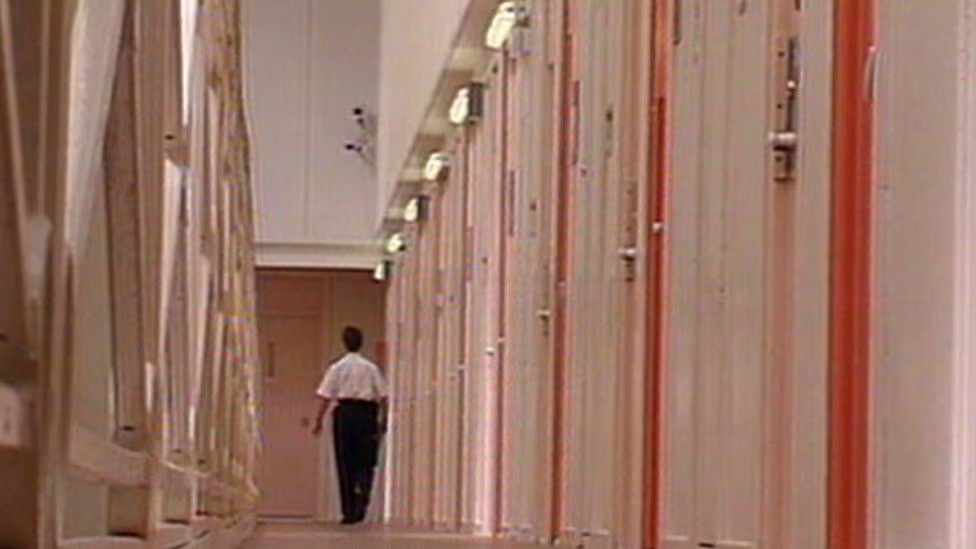
Image source: BBC
Opinion article by The View.