Order the latest issue here
Skip to content Skip to sidebar Skip to footer

Views

She Was Only Walking Home: What the Angiolini Inquiry’s New Report Tells Us About Women’s Safety

The Angiolini Inquiry’s new Part 2 First Report, published on 2 December, is a stark reminder of a truth women already know in their bones: public spaces still don’t belong to us. Four years after the abduction, rape and murder of Sarah Everard by a serving Metropolitan Police officer, this report asks a deceptively simple…

Read more

The System Is Failing Fran: A Woman With Cancer Lost in the Gaps of Probation, Prisons, and Healthcare

At 39, Fran Geary should be focusing on surviving stage two breast cancer. Instead, she is fighting for her life inside a system that treats her illness as an inconvenience rather than an emergency. In this shocking investigation, The View Magazine exposes the dangerous failings that have defined Fran’s journey; from delayed diagnosis to brutal…

Read more

Literature That Transforms: How Stories Illuminate the Realities of Imprisonment

What can a metamorphosing beetle and a kidnapped art student teach us about the lived experience of incarceration? In this powerful literary essay, El Jamieson explores how two classic works – Franz Kafka’s The Metamorphosis and John Fowles’ The Collector – reveal uncomfortable truths about isolation, gender, and the dehumanising nature of imprisonment. At first…

Read more

“Full of Practicality and Humanity”: Judith Moran on 150 Years of Quaker Social Action

Some organisations claim to be rooted in community. Quaker Social Action actually is, and has been for over 150 years. In this intimate and refreshingly honest interview, Judith Moran, QSA’s director, reflects on the charity’s long history, her own working-class upbringing, and why listening is still the most radical tool in social justice work. Growing…

Read more

0

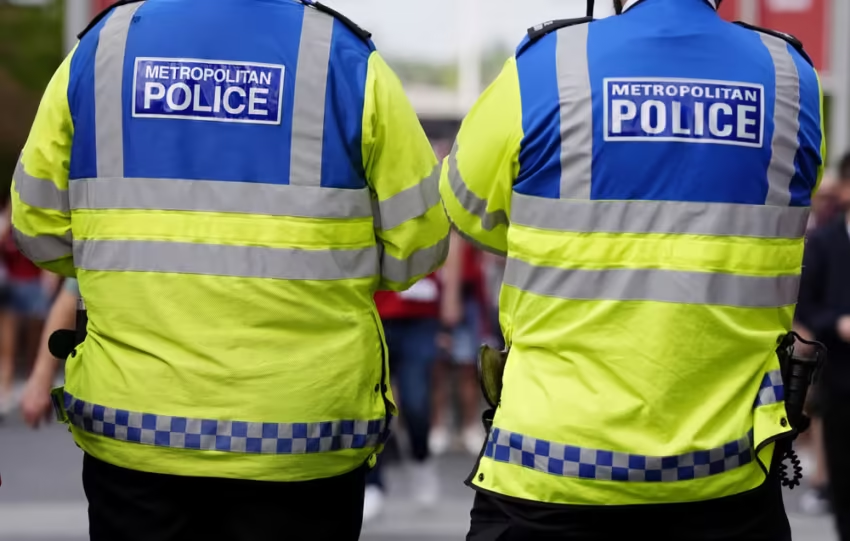
The Angiolini Inquiry’s new Part 2 First Report, published on 2 December, is a stark reminder of a truth women already know in their bones: public spaces still don’t belong to us. Four years after the abduction, rape and murder of Sarah Everard by a serving Metropolitan Police officer, this report asks a deceptively simple question: What is actually being done to stop sexually motivated crimes against women in public?

The answer, laid out across hundreds of pages, is both sobering and galvanising.

We still don’t know how big the problem is

One of the most striking findings is also the most basic: the UK still has no national data on how many women are sexually assaulted in public spaces. There is no standard recording of whether an attacker was a stranger, where the offence took place, or how often women experience harassment, exposure, or predatory surveillance in the everyday spaces we use: streets, buses, parks, stations, inside and outside nightlife venues.

This is astonishing. In an age of granular data collection, women’s safety remains a statistical blind spot.

But women themselves already know the scale. Surveys repeatedly show that most women feel unsafe walking alone at night. They change their routes, clutch their keys, call a friend, speed up, cross the road; rituals of hypervigilance passed down like an unwanted inheritance. As Angiolini writes, women have normalised low-level threat to the point where it becomes invisible to everyone except those living with it.

The prevention landscape is vibrant, but chaotic

The report also documents something hopeful: there are creative, committed, passionate people across the country working to make public spaces safer for women. Local councils redesigning parks. Transport networks using tech to track predatory behaviour. Night-time economy teams training staff to intervene. Police forces piloting new approaches to identifying men who hunt for victims around bars and clubs.

But this energy is scattered. Innovations pop up in one town but never spread. Some brilliant projects lose funding after a year. Others never receive evaluation, meaning no one knows if they’re working, or if they could work even better.

The result is a patchwork, not a system.

Women, yet again, are being asked to carry the load

A thread running through the report and through countless testimonies is deep frustration at prevention messages aimed at women rather than at perpetrators.

“Don’t walk alone.”
“Watch your drink.”
“Text me when you get home.”

As Angiolini notes, women have been doing these things since childhood. They are exhausted by them. And they do not address the root of the problem: the men who offend, or think about offending, or escalate offending.

The Inquiry insists on what feminist campaigners have been saying for decades: to protect women, we need to understand men.

This includes identifying predatory behaviour early, intervening before an offence is committed, and making services available for men who fear their own impulses. Crucially, it also includes ensuring policing has the resources, training and leadership to treat these crimes as preventable, not inevitable.

Project Vigilant and Operation Soteria: rare bright spots

The report highlights two policing initiatives that are working and should be rolled out nationally:

  • Project Vigilant: covert and overt patrols in the night-time economy, trained to spot predatory men. Where it has been used, it has disrupted potential offenders and led to arrests that may otherwise never have happened.

  • Operation Soteria: a radical rethinking of rape investigation, shifting focus from the victim’s credibility to the perpetrator’s behaviour pattern. Early results show improved investigations and reduced opportunities for repeat offending.

These programmes demonstrate what’s possible when attention is placed where it belongs: on the perpetrators, not the women they target.

A whole-system approach — not another short-term fix

Perhaps the most important message is that prevention must be long-term, properly funded, and coordinated across society. The report calls for:

  • a national strategy focusing specifically on sexually motivated crimes in public spaces;

  • multi-year investment in public campaigns and early intervention for boys and men;

  • mandatory national standards in policing;

  • better data, better design, and better accountability.

Women’s safety cannot depend on a flurry of initiatives launched after each tragedy, only to fade when headlines move on. It must be built into how we design cities, run transport, educate children, and hold power to account.

What this report really asks of us

The Angiolini Inquiry is not asking for miracles. It is asking for commitment: from government, from police leadership, from communities, and yes, from men.

Its conclusion is clear: these crimes are preventable. The question now is whether the political and institutional will exists to act.

Because women like Sarah Everard were not simply “walking home.” They were living their lives. And every woman deserves to do that freely, without fear.


Image source: The Guardian