Order the latest issue here
Skip to content Skip to sidebar Skip to footer

Imprisoned for Peace: The Violent Arrest and Persecution of Iran’s Narges Mohammadi

Iran’s ongoing crackdown on dissent reached a grim milestone this week with the violent arrest and imprisonment of Nobel Peace Prize laureate Narges Mohammadi, a leading Iranian human rights campaigner and long-time critic of the regime. Her detention highlights the growing dangers faced by peaceful activists in Iran and the lengths to which the authorities…

Read more

Turner Prize Winner: A historic moment

Artist Nnena Kalu has been announced as the winner of this years Turner Prize, the UK’s most prestigious art award. Her sculptures and drawings, featuring intricate tornado-like shapes and bright colours, earned her the Prize’s recognition, making history as the first artist with a learning disability to be awarded first place.  Kalu is a 52…

Read more

The Gender Justice and Intersectional Practice Conference 2025

The second annual conference on Gender Justice and Intersectional Practice took place this Wednesday on the 3rd of December in Ipswich. It was organised by domestic violence charity P.H.O.E.B.E, formerly known as the Zimbabwe Women’s Resource Centre, and had around 200 attendees. The conference welcomed speakers presenting both academic research alongside advice on the support…

Read more

Quaker Social Action Blog

Poverty in the United Kingdom is often reduced to statistics and headlines, yet behind every number sits a person navigating fragility, rising costs, and decisions that would test any of us. Our conversation with Judith Moran, director of Quaker Social Action, opens a clearer view: poverty as insufficient resources to meet minimum needs, including social…

Read more

0

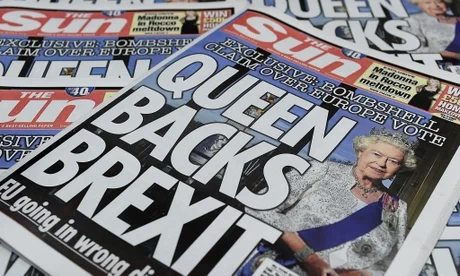
When King Charles delivered his Stand Up to Cancer talk, he spoke passionately about the importance of cancer screening and his own journey of recovery. His words were broadcast across the nation, celebrated as a message of hope. Yet for women in prison across England, the speech was a devastating reminder of their invisibility.

Behind prison walls, women living with cancer are denied access to screening, hospital appointments, and even basic treatment. Their letters and appeals for mercy have gone unanswered. While the King expressed gratitude for reduced treatment next year, incarcerated women cannot even access the most fundamental care. This stark contrast is not just disappointing; it is shameful and unacceptable in 21st-century England.

Cancer does not discriminate, but the justice system does. Women in prison are punished twice: once by the courts, and again by a healthcare system that abandons them. Their suffering is compounded by silence from those in power. When the monarch speaks about cancer without acknowledging their plight, it reinforces a hierarchy of whose lives are deemed worthy of compassion.

This is not a matter of politics; it is a matter of humanity. If cancer awareness is to mean anything, it must extend to those society has locked away. Ignoring these women perpetuates inequality and undermines the very principles of justice and dignity.

The King’s recovery is celebrated, but the women in prison remain unseen. Their struggle is real, urgent, and demands attention. The time for change is now.